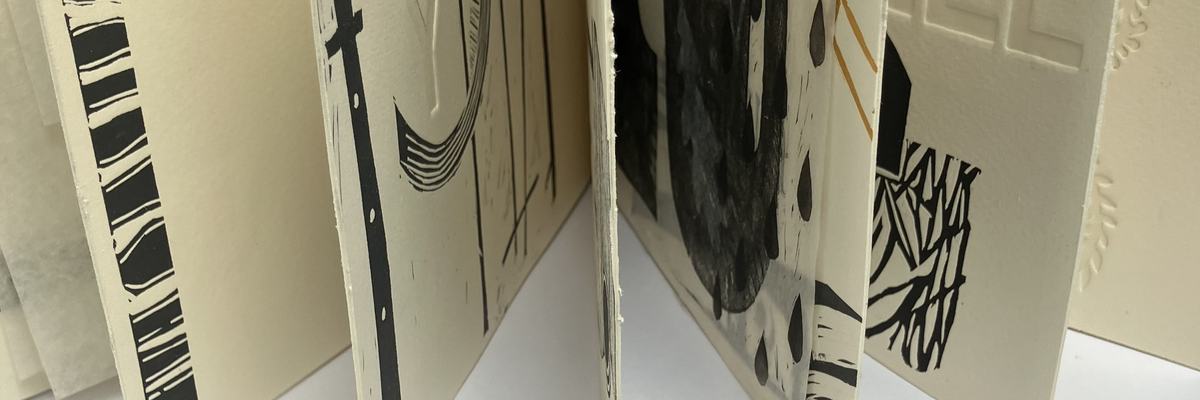
The Joy of Making: Jane Sasanow on Paper, Pebbles and Possibility
“Art for me is something inside which is a core thing; without making and being creative, something is missing in my life.”
From teaching and printmaking to her fascination with nature, materials and artist’s books, Jane reveals how curiosity, experimentation and the joy of making shape her work.
Naomi Ness speaks to Jane.
It’s a humid late-August morning; autumn leaves have started to fall from the trees despite the still-warm temperatures, littering the pavements with colors of gold, brown and yellow.
Stepping into Jane Sasanow’s attic studio feels a little like stepping into the workings of her mind. A heavy caste iron nipping press occupies one side of the room, while a large desk is scattered with materials, books and ideas. A small cat watches from one of the chairs. It is a bright, welcoming space, calm with the sense that there is always something in the process of being made.
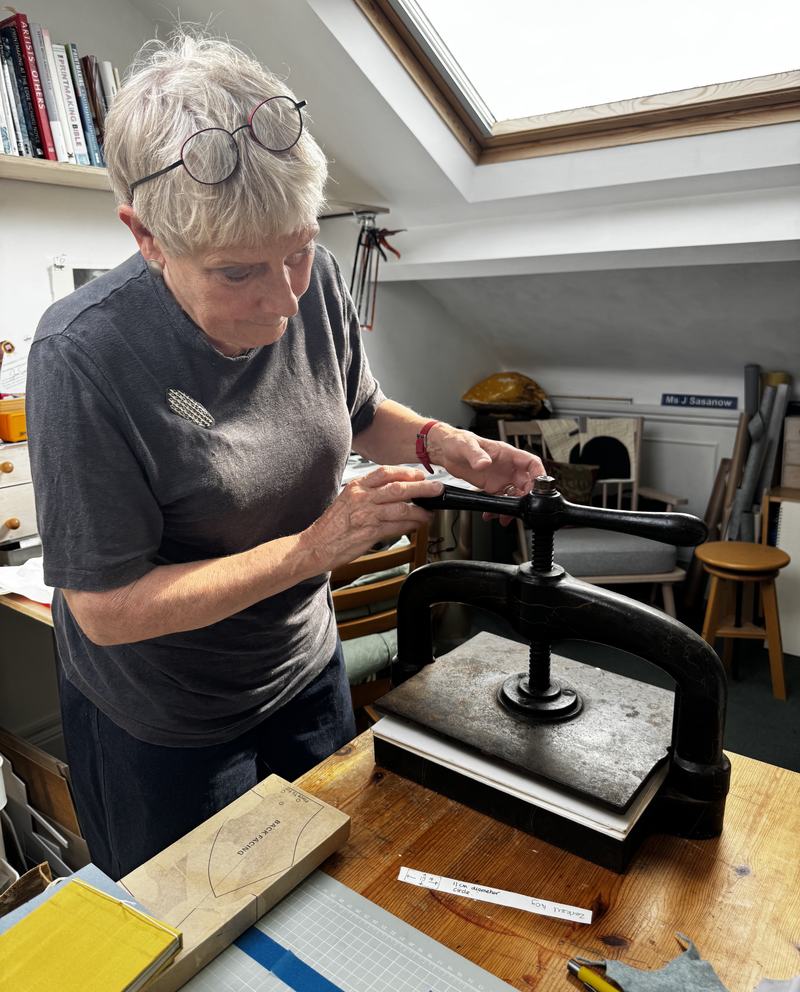
Photography by Naomi Ness
Jane came to Cheltenham after taking a job in the art department at Cleeve High School, where she taught for 23 years after completing a degree in Constructive Textiles at Loughborough. Towards the end of her time at Cleeve, she negotiated a reduced timetable so that she could complete a master’s in Printmaking at UWE. Although Jane considers her career as an artist to have truly begun with her master’s, creativity has always been a constant in her life. She had an aunt who painted and drew and an uncle, who she met as a young adult, who was an architect, and spent her childhood “in the country, reading, cutting, sticking and pasting.”
“Art for me is something inside which is a core thing; without making and being creative, something is missing in my life,” Jane says.
That need to make is at the heart of Jane’s practice. She finds inspiration in fine art, but also in people who understand and handle materials well, including ceramicists and other makers. For her, making is not simply about producing an object; it is a way of understanding and responding to the world around her.
Jane has always collected pebbles. She loves the sea, sand and land, and on her desk are small collections of sand from Cornwall, Formby and Whitby. She is fascinated by the gradual process through which pebbles become sand, by the way they sit on the earth and by the movement of water around them. These processes of erosion, movement, and transformation become a way for her to explore the natural world visually.
Her work transforms textures and forms of nature into layered compositions of paper, print, lettering, and texture. Typography and graphic design have also become an important part of her practice. Jane uses layers of text in her books, playing with lettering and the shapes of individual letters. It was an interest that developed later in life, when she met a colleague who taught graphic design at Cleeve.
“It’s often conversations with other people that educate you,” she says.
That idea of learning through others continues through her involvement with the Stroud Artist Book Group, where she enjoys exploring ideas and seeing how far she can take them. For Jane, an idea does not necessarily arrive fully formed. A small germ can develop slowly into a project, changing and evolving along the way.
Constantly seeing new possibilities is what brings her back to the studio time and time again. The environment and humankind’s relationship with it are recurring themes throughout her work, the history of how we have used the land, and how that relationship has changed over time although her master’s research focused on gender, the socialisation of children, and family.
“I’m a creative butterfly really. With artists’ books you can create anything; and that’s the joy of it. I absolutely love crafting something and resolving design challenges.”
That sense of possibility is perhaps what makes the uncertainty of printmaking so appealing. Jane describes the process of putting a piece through the press as a kind of magic, you may think you know what the finished work will look like, but you never completely know what will emerge.
There is, she says, both “fun and disappointment” in seeing it all come together.
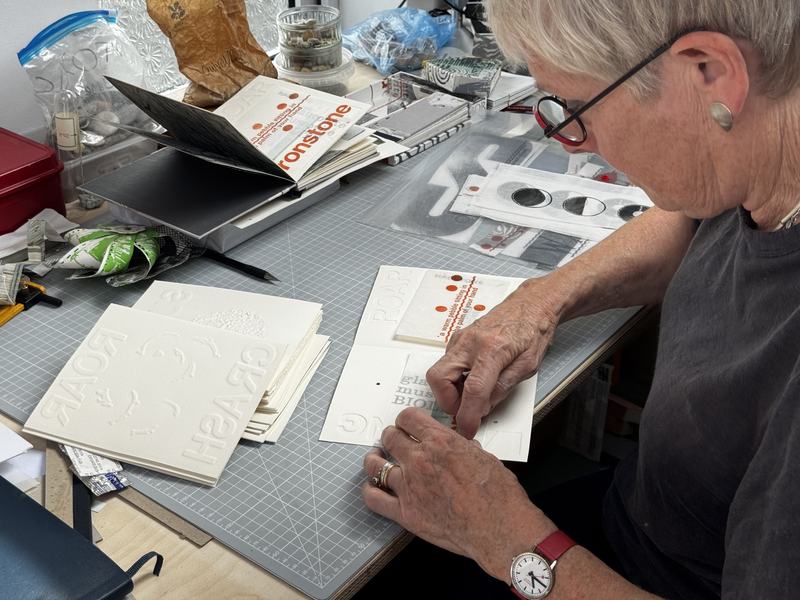
Photography by Naomi Ness
Being an artist also comes with rejection. There is a balance between putting something into the world that you are pleased with and responding to what a customer or exhibition might be looking for. Sometimes the two simply do not align.
Jane, however, does not give up easily.
If there is a possibility of getting something to work, she will keep trying. “It is not easy making continual mistakes,” she says, but those mistakes have become part of what she does and have taught her along the way. If something does not work, or she is unhappy with it, she will often recycle it and find another use for the material.
“Post-war children are brought up not to waste anything,” she says. “There are very few things that I do now that don’t have some merit in some way.”
For Jane, art is therefore less about producing a perfect finished object and more about the continual process of making, experimenting, failing and discovering. The mistake is not necessarily the end of an idea; it can be the beginning of another.
Outside the studio, Jane enjoys spending time with her grandchildren, gardening her allotment and reading. She is also part of a wider creative community in Cheltenham, where she has found inspiration from the many artists and makers around her.
Her own ideas continue to grow. One of her current projects is particularly personal, a book about her family that she hopes to hand down to her grandchildren. Her grandmother passed down a plait of hair to her, and Jane hopes to incorporate it alongside hair from her own children and grandchildren, creating a kind of genealogy box containing information and memories from the family.
It is another example of the way Jane turns ordinary materials into something meaningful, paper becomes a book, sand becomes a study of landscape, discarded work becomes new material, and a plait of hair becomes a physical record of generations.
As we finish, Jane tells me that the one thing she could not live without is paper. And the best thing about being an artist?
The fun.
“It is such fun to make art.”
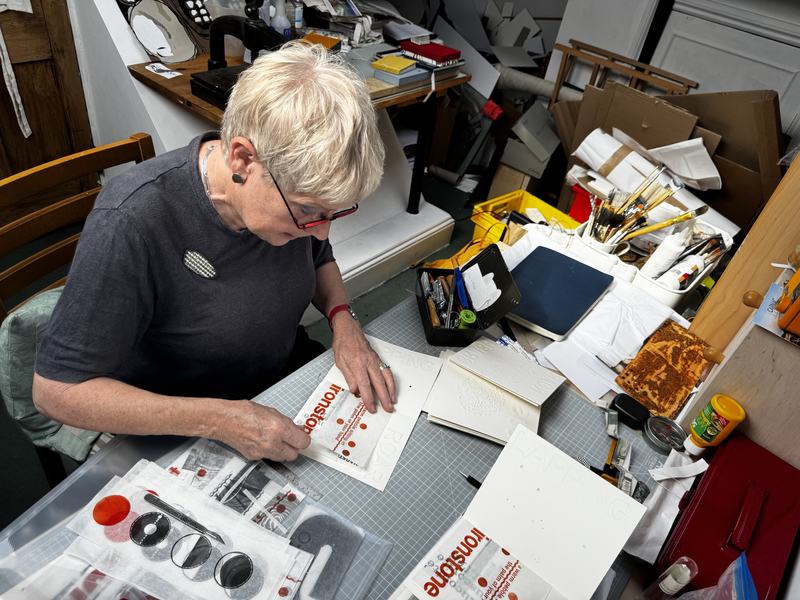
Photography by Naomi Ness
Links
Jane Sasanow on Instagram (@sassyjane6945)
Stroud Artists Books on Instagram (@stroudartistsbooks)
Naomi Ness is a BA student on the Journalism/Communications and Media Course at University of Gloucestershire.
Friends of COS
Support Cheltenham Open Studios
Help us make more noise!
How did you hear about COS? For many, COS is still one of Cheltenham’s best kept secrets. Help us let everyone in on it.
Artist in the Spotlight
The Joy of Making: Jane Sasanow on Paper, Pebbles and Possibility
“Art for me is something inside which is a core thing; without making and being creative, something is missing in …
27 Aug 2026